Burke Devore—Everett B. Dynes
The AxBurke Devore—Everett B. Dynes is a relationship in which professional rivalry collides with an unexpected recognition of shared hardship. Burke initially sees Dynes as an obstacle to the job he hopes to claim; meeting him in Lichgate, however, exposes the human likeness that Burke’s competitive logic tries to suppress. Burke kills him all the same, and afterward names Dynes not simply as a victim but as someone who should have been an ally.
A Rival in a Shrinking Labor Market
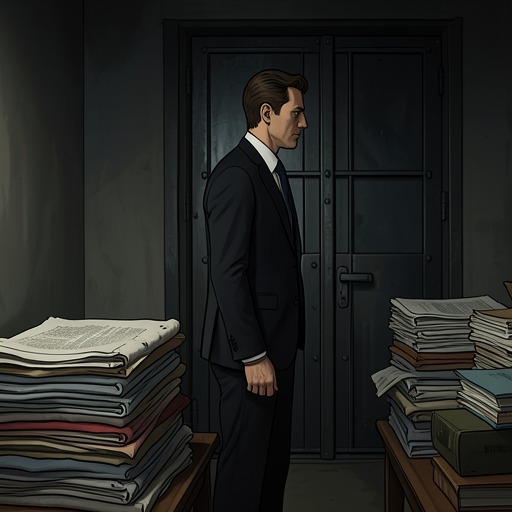
Burke’s view of Dynes takes shape within the broad competition created by corporate layoffs. He describes workers expecting unemployment to be a short interruption, only to find that companies are dismissing people across industries while fewer employers are hiring. In the paper business, the latest wave of downsizing had occurred two years earlier. The résumés Burke has collected belong to people laid off around the same period, from roughly six or seven months before his dismissal to six or seven months after it. To him, this cohort is the labor pool he must defeat before another cycle of reductions sends a new wave of applicants after the same scarce positions.
Burke distinguishes between applicants he considers mismatched and those who threaten him directly. Many send résumés indiscriminately, without the specialized experience required for his area of industrial paper; others, in his view, have qualifications close to his own, or even slightly stronger. Their education may look more distinguished on paper, making them plausible choices for the position Burke wants. Dynes belongs to this second category. Burke’s invented opening is designed to resemble a job appropriate to his own experience, and the applicants it attracts become a means of identifying people he regards as competitors.
The professional comparison is substantial. Dynes’s résumé records twenty-two years in the paper industry across sales, design, customer relations, and management, including nine years in specialized polymer-paper applications. He had worked with customers and designers, managed a product line, coordinated design and production teams, and been responsible for a production crew of twenty-seven. That breadth makes him more than a name in Burke’s files: his background places him squarely in the kind of experienced middle management that Burke believes is being forced to compete for a shrinking number of jobs.
Recognition in Lichgate
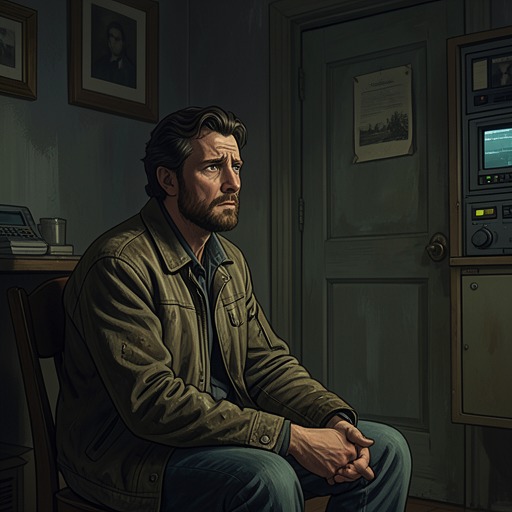
When Burke encounters Dynes in Lichgate, he discovers him working behind a counter, wearing a green apron and carrying fish and chips to a customer. The sight unsettles Burke. Dynes had spent twenty-five years in the paper business, but now worked shifts of eight hours a day, four days a week, from four until midnight. Burke understands the job as a stopgap rather than a restoration of the professional life Dynes had lost. The contrast between the production-line manager’s résumé and the diner work makes the consequences of displacement visible in one ordinary scene.
Dynes’s manner deepens Burke’s discomfort. He approaches with a pleasant smile and an easygoing air, then notices that Burke is looking for work. Rather than treating him as an adversary, Dynes responds with sympathy, saying that he recognizes the condition because he has been through it and is still in it himself. Burke tells him the truth about being unemployed. For a moment, the conversation is not between an applicant and a rival but between two men who understand the same insecurity from experience.
Their circumstances are not identical, but the overlap is unmistakable. Burke’s expertise in paper has not protected him from the glut of qualified applicants or employers unwilling to train someone who is merely capable. Dynes’s long career has not returned him to comparable work either. The encounter gives Burke direct evidence that a person with decades of relevant experience can be reduced to whatever work is available, while also bringing face to face the competitor he had previously been able to treat as a résumé.
Shared Diagnosis, Opposed Uses
Dynes speaks about unemployment as a social failure rather than a private shortcoming. He tells Burke that he has spent the last couple of years thinking about what has happened and regards society as having gone wrong. His comparison is stark: other societies, he says, have abandoned infants or older people they could not support, whereas this society discards productive people in their prime. The speech places his own counter work within a larger judgment about how economic change treats experienced workers.
Burke recognizes the force of this diagnosis, but he does not let it change his conduct. He, too, sees displaced workers as casualties of a system in which employers can choose from an abundant supply of specialists and avoid training anyone. He explains that companies no longer need to hire a broadly capable manager and refine that person’s skills; they can select someone already trained for the precise function, often willing to accept lower pay and fewer benefits. Yet Burke converts this shared analysis into a rationale for eliminating individuals who might take the position he wants. Dynes’s solidarity makes him more difficult to regard as an anonymous competitor, without making him safe.
That contradiction is sharpened by Burke’s account of automation. He sees computers replacing middle managers, whose work had been to carry orders downward, report results upward, and relay information between production, suppliers, and distributors. A few managers may remain to perform specific tasks for the computer, but far fewer are required. At the same time, Burke believes a human manager is still needed to run the production line and communicate with its workers. The job he hopes to secure therefore exists within the very restructuring he condemns: a diminishing occupational tier leaves him and Dynes fighting over the roles that survive.
Murder and the Recognition Afterward
Burke’s planned response to the rivalry is deliberate. He thinks about seeing Dynes after midnight, when darkness would make the victim harder to recognize, and wishes he had brought his Luger. Instead, his final victim in Lichgate is killed when Burke deliberately runs him down with his automobile. The difference between Burke’s cold anticipation and the encounter’s earlier conversation is central to the relationship: he has heard Dynes describe the same social abandonment that shapes his own life, yet still acts on the belief that a rival must be removed.
After the killing, Burke cannot maintain that division between himself and his victim. Awake at Dawson’s Motel, he remembers the event on Nether Street and asks himself how he could have done what he did. He thinks that Dynes was like him and should have been his friend and ally, someone with whom he might have stood against their common enemies. Instead, Burke recognizes that they have been made to claw at each other for scraps while those above them either laugh or fail to notice them. This is not a defense of his act: Burke calls himself responsible, expresses sorrow for the people he has killed and their families, and decides that he must confess and do no more.
In his confession, Burke identifies Dynes as his final victim and states that he deliberately struck him with his car. The relationship’s ending thus joins two facts Burke had kept apart: Dynes was a genuine competitor for work, and he was also a fellow displaced worker whose experience resembled Burke’s own. The recognition arrives too late to prevent the murder, but it breaks through Burke’s abstraction of applicants as obstacles and becomes part of the remorse that leads him to resolve to confess.